
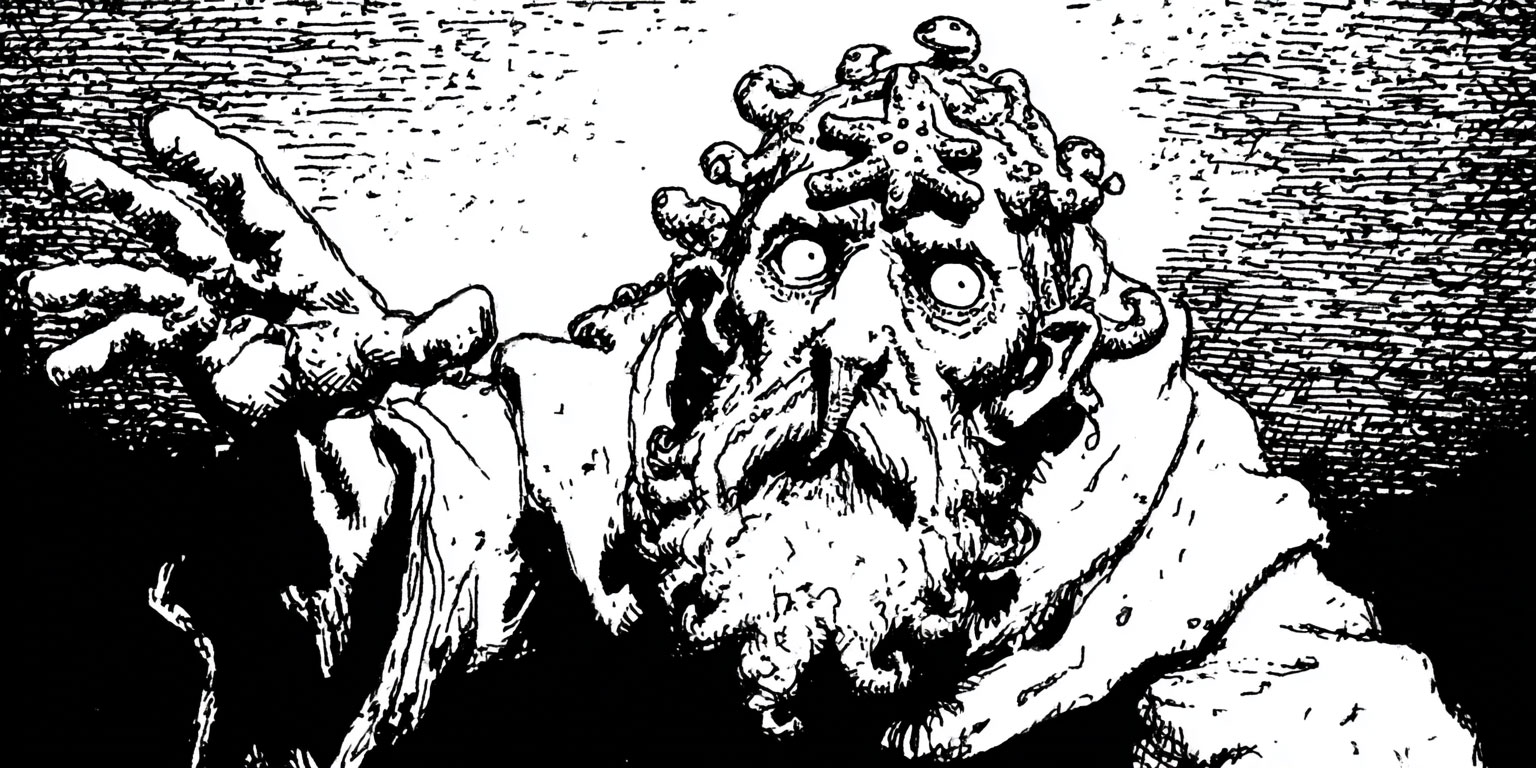
Ceremorph (Thrall)
Passive
Active
- Grapple +6 : 0 (Ensnare)
- Sonic Baton +6 : 4 (Crushing, Sound)
- Soporific Needle +6 : 3 (Sleep, Piercing)
Lore
It has been three days since the tadpole slithered into her ear. Your friend’s silence is a horror unto itself. Her gaze is hollow. She’s become disturbingly placid. But behind her eyes… you see a quiet and calculating hate.
A Ceremorph Thrall is a humanoid infected by a Ceremorph tadpole, an eldritch larva that rewrites the identity of its victim to help facilitate its evolution a fully fledged Ceremorph through a process called ceremorphosis. In the far off saline pools of the Elder Cerebrum, such creatures are birthed as small, barely motive lumps of purplish flesh with whiplike tendrils. Clammy, graying or translucent skin, muscles atrophied into tumorous cerebral material, and newly developed nictating membranes over the eyes are indications of the transformation’s progress. In some, tentacles or veined ridges swell beneath the skin, suggesting the development of the Ceremorph’s grotesque true form. Early during the transformation, Thrall movements and speech may seem clumsy or erratic, until the unseen hand that puppets the Thrall gains full control over the victim’s motor functions. Though Thralls retain their pre-transformation skills, equipment, and abilities, they act as extensions of the Ceremorph Hive. Thrall mentality is buried beneath the Hivemind’s psychic influence and completely beholden to its will. A trace of the old self might surface only for a brief moment, before vanishing into a flooded ego. For the Ceremorphs, Thralls are not just tools, but the means by which their kind propagates in the material realm. Thralls who fail to complete the ceremorphosis end up patrolling Ceremorph colonies as slaves, helplessly faithful to the disturbing power of the denizens of the Outer Realms.
Ceremorph Thralls are pitiable pawns to the Ceremorph Hivemind, which sees through their eyes and controls their bodies remotely. Thralls are always humanoid (the Hivemind views non-humanoids as inferior hosts), and during ceremorphosis, a Thrall retains the full capabilities of its original form (both mental and physical), allowing you to customize encounters involving them in any way you can imagine. When a Thrall is created, the transformation sequesters its memories and suborns its personality to that of the Hivemind. Restoring a Thrall means removing the tadpole in their brain (which is dangerous and can kill the host), and then casting restorative spells over a period of time to dispel the psychic influence of the Hivemind. As a result, memories may be lost because they were absorbed by the Hivemind; only by creating a psychic link with the Ceremorph that created the tadpole can they be recovered. While Thralls undergo ceremorphosis, they obey the Hivemind without regard for their own well-being. Thralls share attributes in common with their masters: a resistance to magic and a vulnerability to light. Notably, spells that have the potential to sever the psychic link between a Thrall and the Hivemind only work temporarily, as the Hivemind’s will is stronger than any one spellcaster’s. Use these moments of lucidity as gut-wrenching roleplay opportunities, especially for NPCs the party have lost to Ceremorph domination.